
Introduction
AI adoption in service management should be measured by more than the introduction of a new technology. The real question is: What changes for the service team and the customer?
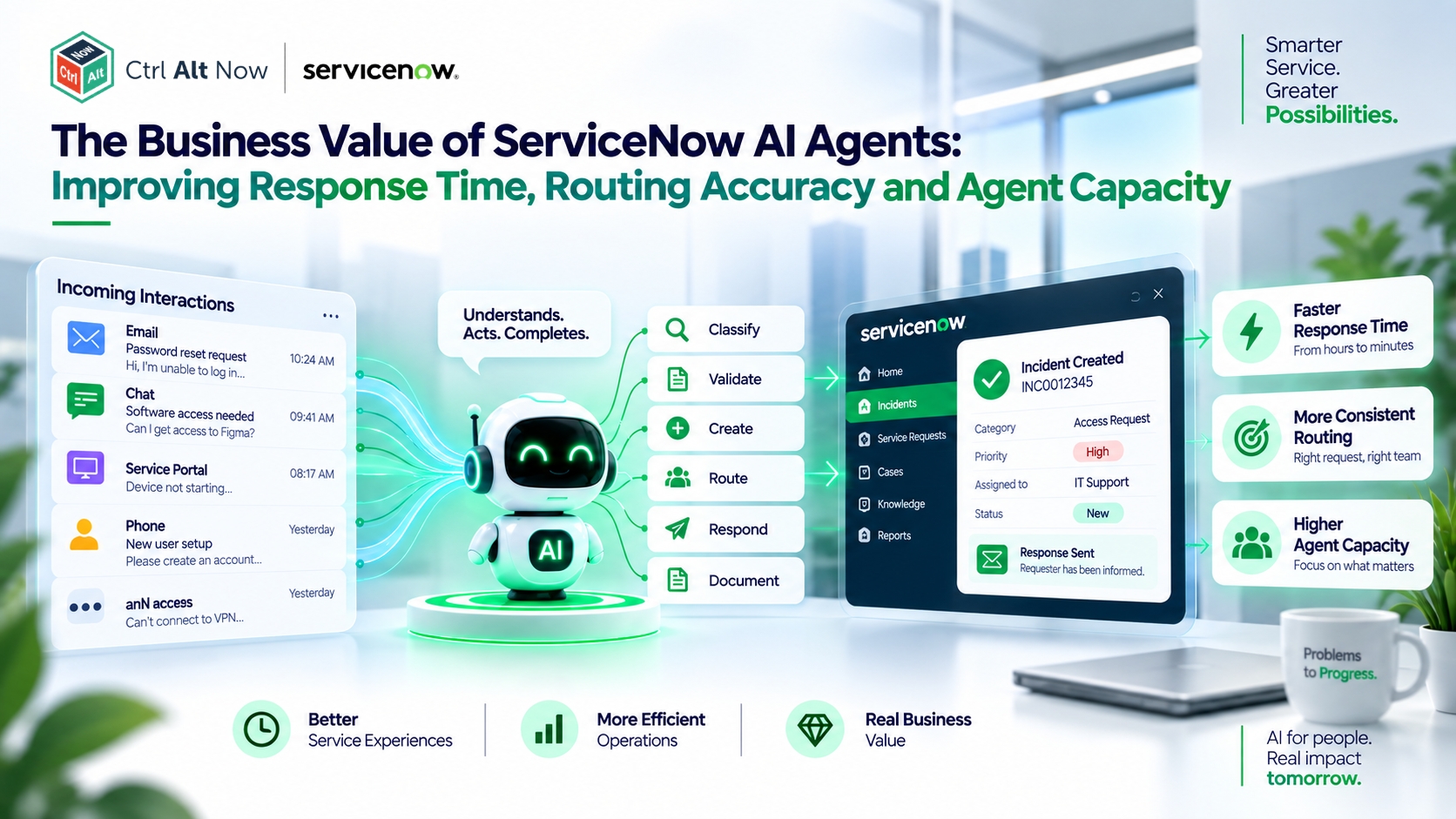
When interaction triage is automated effectively, three important areas can improve: time to first response, routing consistency, and service desk agent capacity.
A ServiceNow AI agent can take responsibility for repetitive intake activities—from understanding an incoming interaction to creating the appropriate record and sending an initial response. This allows human teams to spend more time on diagnosis and resolution.
1. Faster Time to First Response
From Queue-Dependent Responses to Immediate Acknowledgement
In a traditional service desk environment, an incoming request may wait in a queue until an agent becomes available.
The AI-powered approach changes this sequence.
When an interaction arrives, the agent can process it immediately, determine what type of record is required, and generate a contextual acknowledgement.
The source content describes the potential response time as around one minute, rather than hours dependent on queue pickup. This should be treated as a directional claim unless supported by measured results from a defined sample.
Better Customer Experience Starts with Acknowledgement
Customers want to know that their request has been received and is being handled.
An automated first response provides immediate acknowledgement while allowing the service team to work on the underlying issue.
This creates a more responsive experience without requiring human agents to manually send every initial communication.
2. More Consistent Routing
Removing Variability from Manual Intake
Manual classification can vary between agents and even from one day to another.
Two similar interactions may potentially be categorized or routed differently depending on who reviews them.
An AI agent can apply configured rules consistently when determining classification, category, and assignment group.
Confidence-Based Decision Making
Interaction triage can include a confidence level with classification decisions.
This is particularly important because automation should not mean blindly creating records for every message.
When an interaction does not contain enough information, the agent can use a clarification path rather than creating a half-formed record.
This creates a more controlled approach to autonomous service management.
3. Recovering Agent Capacity
Shift Human Effort from Intake to Resolution
Service desk professionals should spend their time solving problems, investigating complex issues, and supporting customers—not repeatedly copying information from emails into records.
By automating repetitive intake activities, organizations can redirect agent effort toward higher-value work.
The intended shift is straightforward:
Manual Intake → Automated Intake → Human Resolution
Instead of opening a queue and starting the administrative process, agents can receive an already-created and appropriately routed record.
Supporting Continuous Coverage
Traditional service desk intake is often constrained by business hours and staffing availability.
An autonomous AI agent can operate when human teams are unavailable, including nights and weekends, enabling continuous interaction handling.
This does not mean every issue should be resolved autonomously. Rather, the intake and acknowledgement stages can continue even when the human service team is offline.
What the AI Agent Actually Automates
The value becomes clearer when looking at the complete workflow.
Step 1: Classify
The agent determines whether the interaction represents an incident, request, or case.
Step 2: Validate
It checks whether enough information exists to proceed.
Step 3: Determine Fields
Relevant information such as short description, category, and assignment group is resolved.
Step 4: Create the Record
The appropriate record is automatically created and linked to the originating interaction.
Step 5: Respond
A contextual first response is generated and sent to the requester.
Step 6: Document
The interaction receives a summary of what the agent created, where it was routed, and what response was sent.
Why This Is More Than Simple Automation
A Closed-Loop Service Process
Traditional automation may address one individual task.
Interaction triage takes a broader approach by connecting multiple activities into a single workflow.
The agent does not stop after classification. It continues through validation, record creation, routing, communication, and documentation.
Autonomous but Accountable
Autonomous service management also requires visibility.
The source content emphasizes that decisions—including confidence—are written back to the interaction record. This creates an auditable trail rather than treating the AI process as an unexplained black box.
Building a Progressive AI Strategy
Organizations do not have to move directly from manual processes to completely autonomous operations.
A progressive approach can begin with assist mode, where human agents review the AI’s actions. As specific categories demonstrate reliable performance, those workflows can gradually move toward autonomous handling.
This approach allows organizations to establish confidence while maintaining appropriate human oversight.
Conclusion
The business case for ServiceNow AI-powered interaction triage goes beyond simply adopting AI.
It is about improving the service experience through faster acknowledgement, creating greater consistency in classification and routing, and recovering valuable agent capacity.
When an AI agent can triage, validate, create, route, respond, and document an interaction, the service desk can move from an intake-focused model toward a resolution-focused model.
For organizations pursuing more responsive and scalable service operations, this closed-loop approach provides a practical foundation for the next stage of AI-driven service management.

Leave A Comment