
Introduction
For many service desks, the first step toward resolving an issue is not actually solving it. It is reading an incoming email or portal interaction, understanding what the requester needs, deciding whether it is an incident, request, or case, checking whether enough information is available, creating the appropriate record, assigning it to the right team, and responding to the customer.
This repetitive intake process can consume valuable service desk capacity and delay the first response.
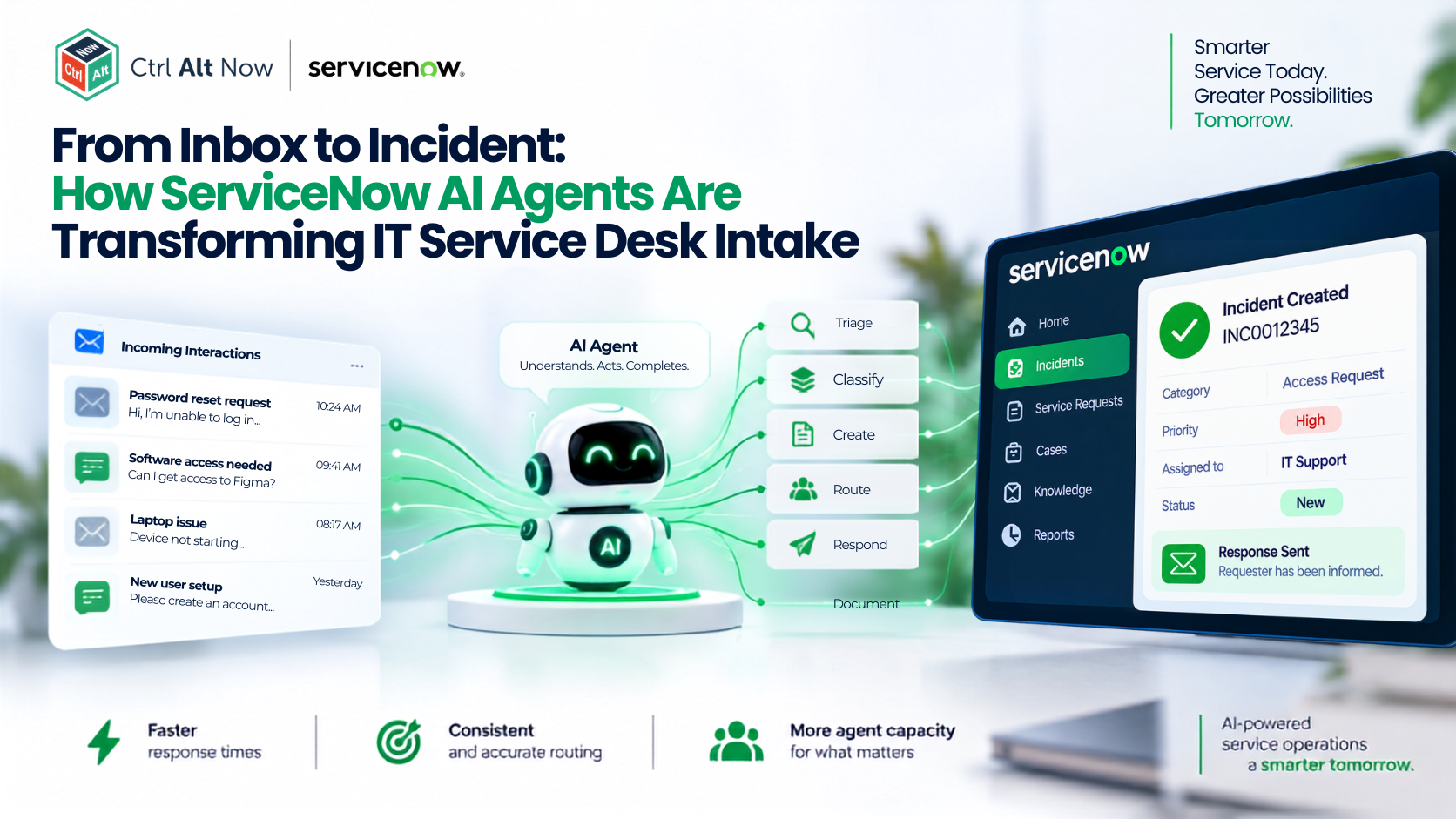
With AI-driven interaction triage, organizations can automate this entire intake journey. A ServiceNow AI agent can read an incoming interaction, classify it, validate the available information, create the appropriate record, route it correctly, and send a contextual first response—allowing human agents to begin with resolution rather than paperwork.
The Challenge: Service Desks Spend Too Much Time on Intake
Manual Classification Creates Delays
When an interaction arrives, a service desk agent must determine what type of request it represents. They may need to distinguish between an incident, service request, or customer case before taking action.
When this process depends entirely on manual review, response times can vary depending on queue volume, staffing, and individual agent decisions.
Repetitive Record Creation Consumes Agent Capacity
After understanding the request, the agent must create a record, enter the relevant information, select categories, identify the assignment group, and communicate with the requester.
While each individual action may seem small, the cumulative effort across hundreds or thousands of interactions can become significant.
Moving Beyond AI Classification
Classification Is Only the Beginning
AI-based classification can determine what an incoming interaction represents, but classification alone does not eliminate the intake workload.
The greater opportunity comes when an AI agent can continue the workflow after classification.
Instead of simply saying, “This is an incident,” the agent can validate the request, determine the necessary fields, create the record, route it, and communicate the next step to the requester.
From Decision to Action
The ServiceNow AI agent follows a complete sequence:
Triage → Validate → Decide Fields → Create Record → Send First Response → Close the Interaction
This creates an end-to-end intake process rather than another isolated automation step.
How AI-Powered Interaction Triage Works
1. Triage the Incoming Interaction
The agent reads the interaction and determines whether it represents an incident, request, or case. It can also propose relevant category, priority, and assignment information with a confidence level.
2. Validate Before Acting
Not every incoming message contains enough information to create a meaningful record.
The agent checks whether sufficient details are available. If the interaction is incomplete or under-specified, it can route the request toward clarification rather than automatically creating a poorly defined record.
3. Determine the Required Fields
Based on the interaction and configured platform rules, the agent resolves information such as short description, category, and assignment group.
4. Create and Link the Record
Once the required information is available, the appropriate incident, request, or case is created and linked to the originating interaction. This maintains traceability throughout the process.
5. Send the First Response
The requester receives a contextual acknowledgement containing the relevant reference and expected next step.
This means customers do not necessarily have to wait for a human agent to acknowledge their request.
6. Document the Action
The interaction is updated with a summary of what was created, where it was routed, and confirmation that the first response was sent.
This provides an auditable trail of the agent’s actions.
Why the Closed-Loop Approach Matters
The real value of interaction triage is not simply automation. It is completing the intake process.
By the time a human service desk agent opens the queue, the record can already exist, contain the relevant information, be routed to the appropriate team, and have a customer acknowledgement associated with it.
The human agent can therefore focus on diagnosis and resolution instead of repetitive administrative work.
Built on ServiceNow Capabilities
The interaction triage approach described here is built using ServiceNow Now Assist, AI Agent Studio, and Flow Designer and can support ITSM and CSM interaction channels, including email and portal interactions.
This provides a structured approach to introducing autonomous AI into service operations while maintaining visibility into the decisions and actions taken by the agent.
Conclusion
The future of service desk automation is not simply about identifying what an incoming message means. It is about turning that understanding into action.
A ServiceNow AI agent can move an interaction through triage, validation, record creation, routing, customer acknowledgement, and documentation. The result is a service desk that can begin closer to resolution instead of starting with intake.
For organizations looking to improve responsiveness, consistency, and service desk throughput, AI-powered interaction triage represents a practical step toward more autonomous service operations.


Leave A Comment