
Introduction
The AI transformation conversation often centers on large enterprises—the global organizations investing millions into experimentation, automation, and digital reinvention. But while enterprise giants dominate headlines, a different opportunity is quietly emerging for mid-market companies.
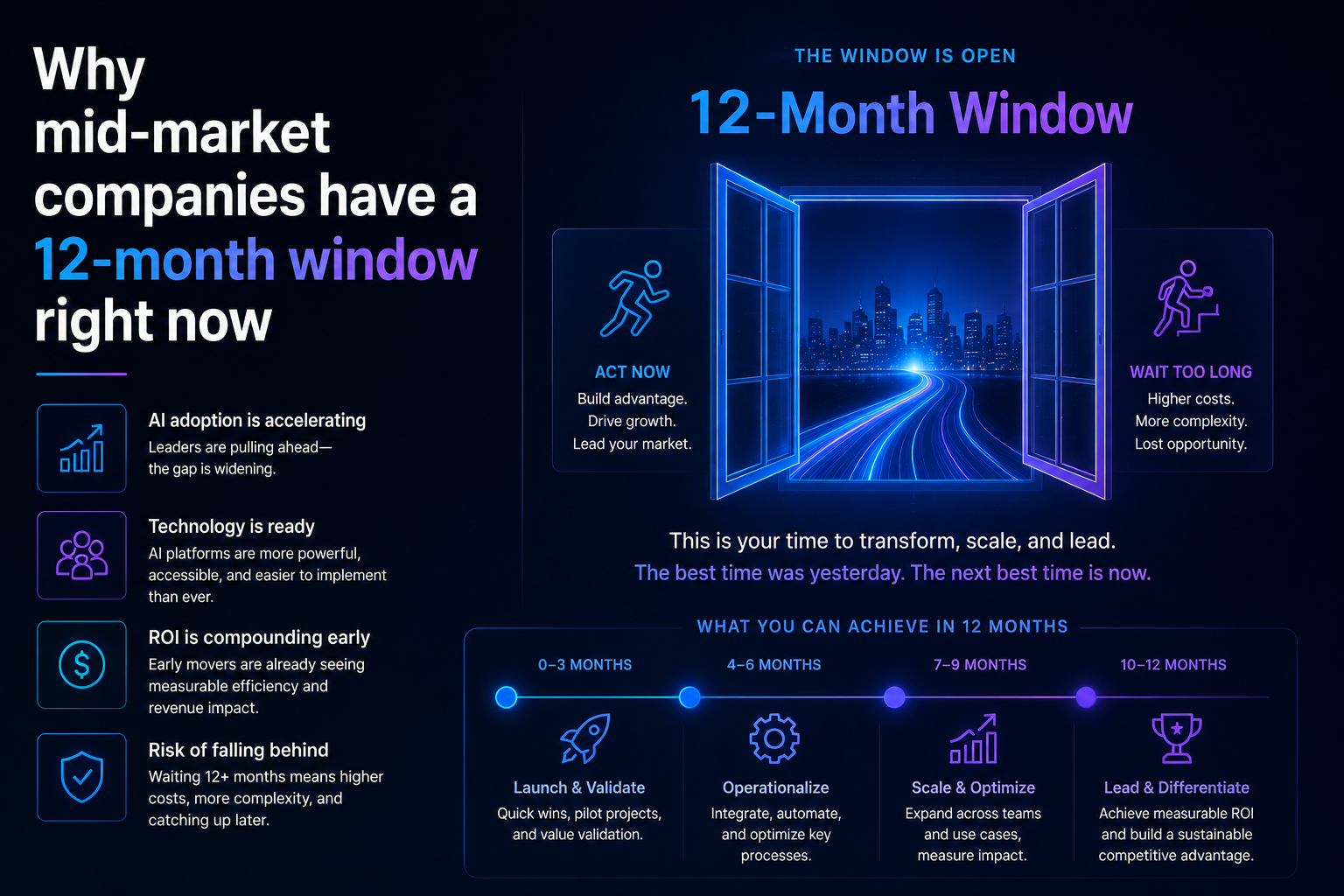
In many ways, the next 12 months may represent one of the most important strategic windows for mid-sized organizations. As enterprise AI adoption accelerates, companies that act now have a chance to modernize operations, establish governance foundations, and build AI-ready business models before competition intensifies.
For mid-market businesses, timing may become one of the biggest competitive advantages.
The Market Is Still in Its Early Stages
Despite growing momentum around AI, enterprise execution models are still developing. Large organizations are actively experimenting with autonomous workflows, intelligent orchestration, and AI-driven operations—but implementation at scale remains slow.
The reason is simple: complexity.
Many enterprises are burdened by fragmented systems, legacy infrastructure, regulatory constraints, and organizational silos that make transformation difficult. While they possess larger budgets, they often struggle with execution speed.
This creates an unusual market condition—one where mid-market organizations can move faster and potentially leap ahead.
Faster Decision-Making Creates Momentum
One of the biggest advantages mid-market companies possess is speed.
Unlike large enterprises that require layers of approvals, long procurement cycles, and cross-functional alignment, mid-sized organizations can often make strategic technology decisions quickly. This agility allows them to pilot new systems, adjust workflows, and implement operational improvements without lengthy delays.
In an environment where AI capabilities are evolving rapidly, speed matters. Organizations that wait too long may find themselves reacting to competitors rather than shaping their own transformation journey.
Leaner Operations Enable Faster Change
Mid-market companies often operate with leaner teams and more streamlined structures. While this may sometimes feel like a limitation, it can become a major strength during periods of technological change.
Fewer operational layers mean less friction when introducing new platforms, redesigning workflows, or aligning teams around AI initiatives. Instead of untangling years of technical debt, many mid-sized businesses can modernize with greater flexibility.
This reduced legacy overhead creates a rare opportunity to adopt smarter systems without the complexity that slows larger organizations.
Building an AI-Ready Foundation Before the Rush
The next 12 months are likely to be critical for companies looking to prepare for the next generation of enterprise operations.
Forward-thinking mid-market organizations should focus on three priorities:
Modernizing Workflows
Outdated, manual processes limit scalability. Streamlining workflows now can prepare operations for future AI integration.
Unifying Operational Data
AI depends on connected, accessible data. Breaking down silos and creating unified visibility will become increasingly important.
Establishing Governance Models
Responsible AI adoption requires accountability. Building governance frameworks early will help organizations scale confidently as automation expands.
Conclusion
Mid-market companies are in a uniquely favorable position. While larger enterprises wrestle with operational complexity, smaller and mid-sized businesses have an opportunity to move faster, adapt sooner, and establish AI-ready foundations before widespread adoption reshapes industries.
The next 12 months may not simply be another technology cycle—they could define which organizations lead and which struggle to catch up.
For mid-market companies, the advantage is not scale. It is speed, agility, and the willingness to act before the market fully shifts.


Leave A Comment