

Introduction
Artificial Intelligence has become a standard part of enterprise conversations, with organizations proudly claiming their products are “AI-powered” But not every AI solution is truly intelligent. Many simply automate predefined tasks without making any real decisions. While building an AI Agent in ServiceNow’s AI Agent Studio to evaluate and prioritize ideas, we encountered this distinction firsthand. Our journey revealed that the real value of AI lies not in automation alone, but in its ability to reason, justify decisions, and adapt to the quality of information it receives.
From Automation to Intelligence
The Starting Point: A Calculator, Not an Agent
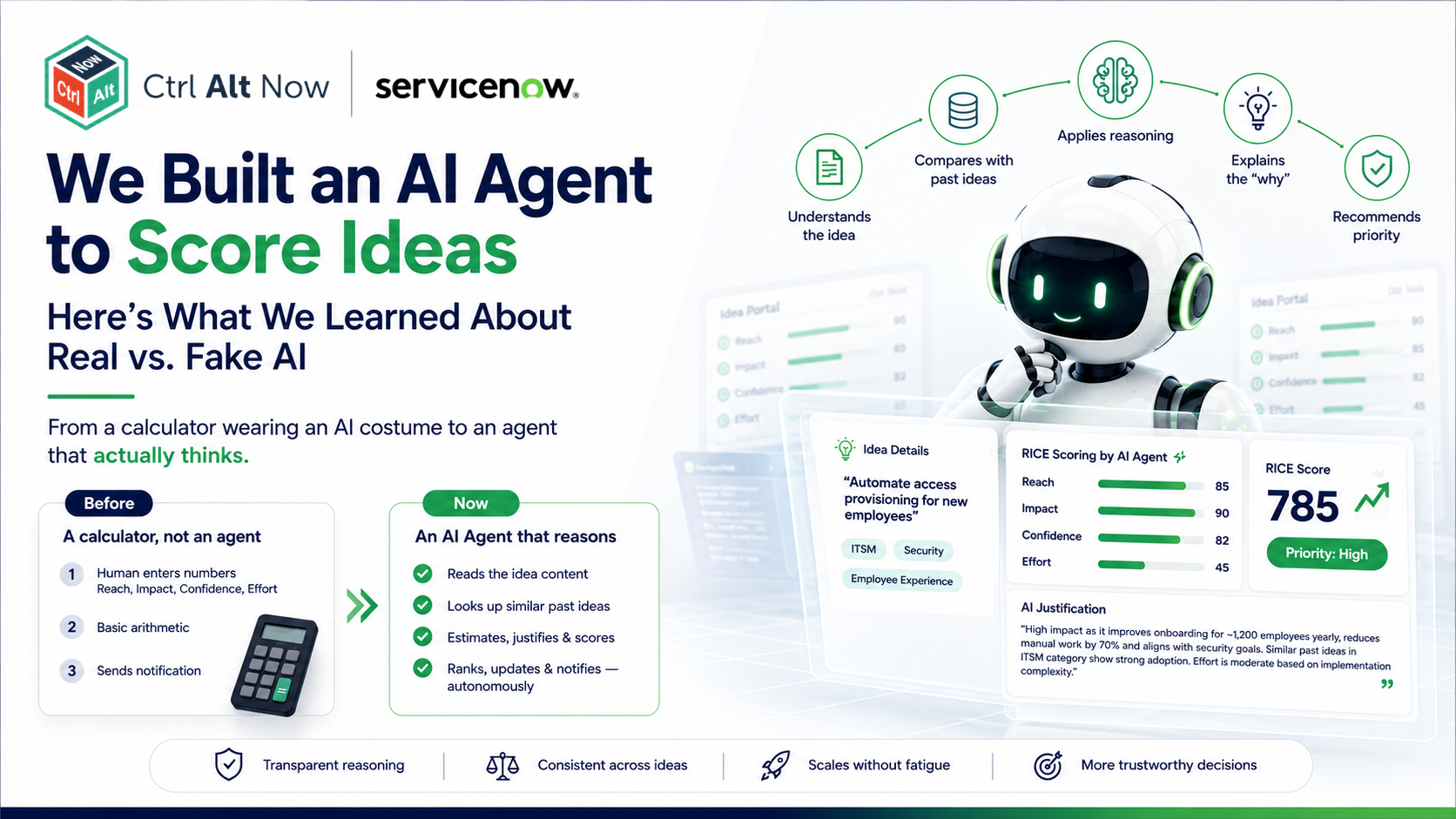
The existing idea evaluation process followed the RICE framework—Reach, Impact, Confidence, and Effort. Users manually entered these four values, while the “AI agent” merely calculated the final score and triggered a notification. Although branded as AI, it wasn’t making any judgments. The intelligence came entirely from the person submitting the idea.
Rebuilding the Agent to Think
We redesigned the solution with a different objective: allow the AI to evaluate ideas the way an experienced product manager would. Instead of relying on user-provided scores, the agent reads the idea’s title, description, and category, retrieves comparable ideas for context, estimates each RICE parameter independently, and generates a plain-English explanation for every estimate. It then calculates the RICE score, ranks the idea, recommends a priority, updates the record, and notifies the approver all without requiring manual scoring.
How We Validated Real AI Reasoning
The Test That Made the Difference
To verify that the agent was genuinely reasoning, we compared two very different ideas: one with a vague description and another with detailed business context, affected users, and expected outcomes.
The results were exactly what we hoped for. The detailed proposal received a higher Confidence score, while the vague submission was assigned a lower score with a clear explanation that limited information reduced certainty. This demonstrated that the agent wasn’t producing generic outputs—it was evaluating the quality of the input and adjusting its reasoning accordingly.
Designing the Right Level of Autonomy
When Should AI Decide?
One of the most important architectural decisions was determining how much autonomy to give the agent. Should every recommendation require human approval, or should the AI act independently?
For idea prioritization, we chose full autonomy because the benefits of eliminating manual triage outweighed the risk of occasional imperfect assessments. However, this isn’t a universal rule. Higher-risk business processes may still require human validation before decisions are finalized. Effective AI design is about balancing autonomy with accountability.
Key Takeaway
The biggest lesson from this project is that an AI agent is not defined by the platform it runs on or the label attached to it. It’s defined by its ability to analyze information, make informed judgments, explain its reasoning, and produce outcomes that change based on the quality of the input. Those design choices matter far more than the technology stack itself.
Conclusion
As organizations continue investing in AI, it’s worth asking a simple question: Is the system actually making intelligent decisions, or is it simply automating a workflow? If vague and well-defined inputs produce the same output, you’re likely looking at automation with AI branding. But if the system can distinguish between weak and strong ideas, justify its conclusions, and adapt its recommendations accordingly, you’ve built something far more valuable an AI agent that truly contributes to better decision-making.


Leave A Comment