
Introduction
Agentic AI is changing how enterprises use artificial intelligence. Instead of simply generating recommendations or responding to user prompts, AI agents can interpret information, make decisions, interact with enterprise systems, and execute workflows with varying levels of autonomy.
For CISOs, this creates an important shift in cybersecurity priorities.
Traditional security programs were largely designed around protecting systems and controlling what human users could access. Agentic AI introduces another category of identities that can act across applications, data, and workflows: AI agents and other non-human identities.
As enterprises adopt ServiceNow AI Agents to automate IT, security, employee, and business workflows, security teams need to ensure that these agents have the right permissions, operate within defined boundaries, and remain accountable for their actions.
The key question for CISOs is no longer simply whether an AI agent is useful. It is whether the agent can operate safely, securely, and transparently at enterprise scale.
What Is Agentic AI Security?
Agentic AI security refers to the security controls, governance processes, and monitoring capabilities used to protect AI agents and the systems they interact with.
An AI agent may have access to enterprise data, applications, APIs, workflows, and business processes. If that access is broader than necessary, a compromised or incorrectly configured agent could create significant security exposure.
ServiceNow’s current AI Agent Security capabilities focus on discovering AI agent identities, understanding their permissions and access paths, reducing excessive privileges, assigning ownership, and continuously monitoring risk.
For CISOs, this means treating AI agents as a new security and governance surface rather than simply another software feature.
Why Agentic AI Changes the CISO’s Security Model
From Human Users to Autonomous Actors
Traditional identity security primarily focuses on employees, contractors, administrators, and other human users.
Agentic AI introduces autonomous actors that can perform tasks on behalf of users or business processes. These agents may interact with multiple systems and execute actions without requiring a human to manually perform every step.
This creates new questions:
- What identity does the AI agent use?
- What data can it access?
- What actions is it allowed to perform?
- Who owns the agent?
- What happens if its permissions change?
- How are its actions monitored?
- Can its decisions and actions be audited?
ServiceNow describes this shift as moving from securing systems people use to securing systems that can act.
1. Identity and Access Control Must Come First
Every AI Agent Needs a Defined Identity
CISOs should know exactly which AI agents exist within the enterprise and what identities they use.
An unmanaged AI agent can become similar to an unmanaged service account: it may continue to have access even when its original business requirement has changed.
A mature security approach should provide visibility into:
- AI agent identity
- Agent owner
- Applications accessed
- Data accessed
- APIs and tools used
- Permissions assigned
- Business purpose
- Current status
- Last activity
ServiceNow’s AI Agent Security approach treats AI agents as identities that can be discovered and mapped alongside human and other non-human identities.
Apply the Principle of Least Privilege
AI agents should receive only the permissions required to perform their assigned tasks.
For example, an agent responsible for creating an IT incident should not automatically receive broad administrative access to unrelated systems.
Least-privilege access helps reduce the potential blast radius if an agent is misconfigured, compromised, or given malicious input.
ServiceNow’s current security guidance specifically highlights permission mapping, blast-radius reduction, and least-privilege enforcement for AI agents.
2. Protect Enterprise Data from Unnecessary Exposure
AI Agents May Touch Sensitive Information
Enterprise AI agents can interact with information such as:
- Employee records
- Customer information
- IT infrastructure data
- Security incidents
- Financial information
- Business documents
- Application data
- Configuration records
CISOs should therefore understand not only who can invoke an agent, but also what information the agent can access while performing its task.
ServiceNow’s AI agent architecture distinguishes user access from data access and emphasizes controls designed to restrict agents to the data and roles required for their workflows.
Data Access Should Be Context-Aware
An agent should not automatically inherit more privileges than the requesting user or the workflow requires.
Organizations should define appropriate access boundaries before deploying autonomous workflows into production.
3. Establish Human Oversight for High-Risk Actions
Autonomy Does Not Mean Unlimited Authority
Agentic AI can automate many repetitive activities, but not every business decision should be completely autonomous.
CISOs should identify actions that require human approval.
Examples may include:
- Changing privileged access
- Deleting critical records
- Disabling security controls
- Approving sensitive transactions
- Modifying production infrastructure
- Sharing confidential information
- Making high-impact business decisions
ServiceNow’s AI policy states that customers are responsible for determining when human oversight and meaningful human control are required and for evaluating AI outputs for accuracy and appropriateness.
The objective should be governed autonomy, where AI agents can move quickly within clearly defined boundaries while humans retain control over higher-risk decisions.
4. Monitor Agent Behavior Continuously
Security Cannot Stop at Deployment
Deploying an AI agent securely is only the beginning.
Agent permissions, integrations, data sources, and business requirements can change over time. An agent that was appropriately configured six months ago may have excessive access today.
Continuous monitoring should identify:
- Permission changes
- Access drift
- Dormant agents
- Unused privileges
- Unexpected activity
- New integrations
- Ownership changes
- Policy violations
ServiceNow’s AI Agent Security capabilities emphasize continuous monitoring, permission-sprawl detection, and access reviews.
Detect Access Drift
Access drift occurs when permissions gradually expand beyond what is actually required.
Regular reviews can help organizations identify unnecessary permissions and reduce the potential impact of an agent-related security incident.
5. Know the Blast Radius of Every Agent
Why Blast Radius Matters
If an AI agent is compromised or behaves incorrectly, CISOs need to understand how far the impact could extend.
Consider an agent that can access multiple applications, databases, APIs, and workflows. Its security exposure is not limited to the system where the agent was initially created.
Mapping access relationships can help security teams understand:
Agent → Identity → Permissions → Applications → Data → Business Services
This context can help organizations prioritize high-risk agents and reduce unnecessary access.
ServiceNow’s AI Agent Security capability includes blast-radius analysis to help identify the potential impact of excessive or risky agent permissions.
6. Assign Clear Ownership and Accountability
Every Agent Should Have an Owner
An AI agent should never become an “orphaned” identity.
CISOs and security teams should be able to answer:
Who is responsible for this AI agent?
Ownership should be connected to the agent’s business purpose, security requirements, access reviews, and lifecycle management.
ServiceNow highlights named ownership for AI agents and alerts related to ownership changes as part of its AI Agent Security capabilities.
This becomes particularly important when employees change roles or leave an organization.
7. Build Auditability into Agentic Workflows
Security Teams Need Evidence, Not Just Policies
A security policy is only useful if an organization can demonstrate that controls are actually operating.
CISOs should have visibility into:
- What the agent did
- When it acted
- Which identity it used
- What information it accessed
- Which workflow it triggered
- What decision or action occurred
- Whether human approval was required
- Who was responsible for the agent
ServiceNow emphasizes continuous compliance evidence and audit readiness for AI-agent access and governance.
Strong auditability can also make incident investigation and regulatory reviews more efficient.
8. Integrate AI Governance with Security Operations
Avoid Creating Another Security Silo
One of the biggest challenges enterprises face is fragmented security tooling.
If AI governance exists in one system, identity information in another, incident management somewhere else, and risk data in yet another platform, security teams may struggle to connect the dots.
A platform-based approach can bring AI governance, identity, risk, security operations, and workflows closer together.
ServiceNow positions AI Control Tower as a centralized governance layer for AI agents, models, and identities, while AI Agent Security provides visibility and controls around agent access.
This can help organizations move from simply identifying AI risks to taking action on them.
A CISO Checklist for ServiceNow Agentic AI Security
Before deploying or expanding AI agents, security leaders should ask:
Identity
- Does every AI agent have a unique and identifiable identity?
- Is an owner assigned to every agent?
- Are inactive or orphaned agents removed?
Access
- Does each agent have only the permissions it requires?
- Can security teams see exactly what data and systems an agent can access?
- Are privileged permissions regularly reviewed?
Governance
- Are AI agents covered by enterprise security policies?
- Are high-risk actions subject to human approval?
- Is there a defined AI agent lifecycle?
Monitoring
- Are permissions and activities monitored continuously?
- Can security teams detect access drift?
- Can they identify an agent’s potential blast radius?
Compliance
- Are agent actions auditable?
- Can the organization produce evidence of access reviews and controls?
- Are AI governance requirements aligned with applicable regulatory obligations?
How CtrlAltNow Can Help Enterprises Build a Secure Agentic AI Environment
Agentic AI can deliver significant value when it is implemented with the right platform foundation, governance model, and security controls.
At CtrlAltNow, organizations can approach ServiceNow AI adoption with security and governance considered alongside automation and business outcomes.
A secure agentic AI strategy should combine:
- ServiceNow AI Agents
- Identity and access governance
- Least-privilege controls
- AI governance
- Security and risk workflows
- Continuous monitoring
- Human oversight
- Auditability
- Enterprise workflow automation
This approach helps organizations move toward AI adoption without treating security as an afterthought.
For enterprises building an AI-ready ServiceNow environment, the objective is not simply to deploy more AI agents. It is to create trusted, governed, observable, and accountable AI agents that can operate safely at enterprise scale.
Conclusion
Agentic AI is changing the enterprise security landscape. AI agents can increasingly access data, interact with applications, trigger workflows, and take actions on behalf of users and organizations.
For CISOs, this creates a new responsibility: securing not only the systems and people within the enterprise, but also the AI agents acting across those systems.
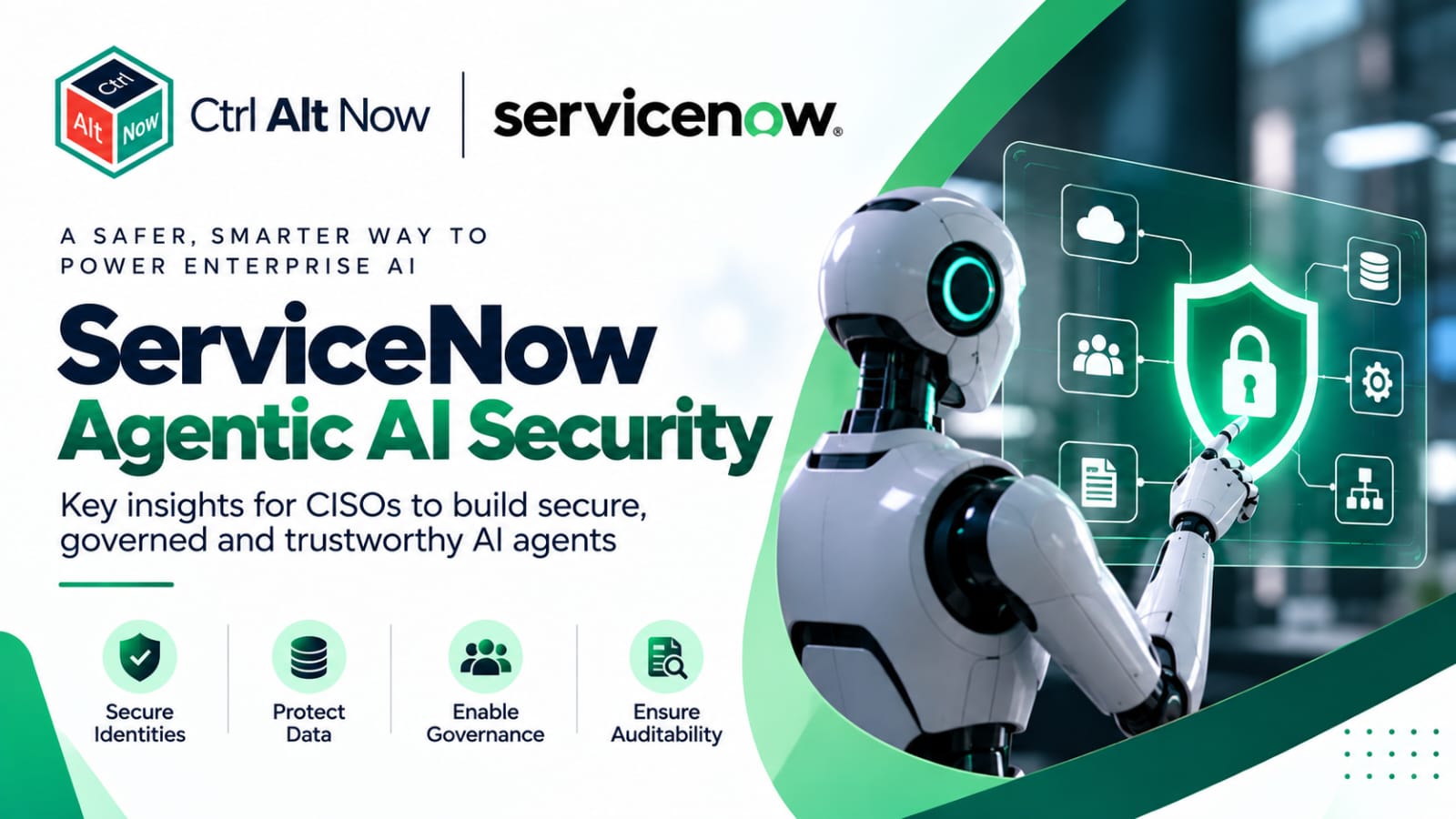
A strong security strategy should focus on identity, least privilege, data protection, human oversight, continuous monitoring, ownership, auditability, and centralized governance.
ServiceNow’s evolving AI security capabilities provide organizations with mechanisms to discover agent identities, understand permissions, reduce excessive access, monitor risk, and connect AI governance with enterprise workflows.
With the right strategy and implementation partner, enterprises can embrace ServiceNow Agentic AI while maintaining the security, control, and accountability that modern CISOs require.
The future of enterprise AI is not just autonomous—it must be secure, governed, and accountable.


Leave A Comment