

Introduction
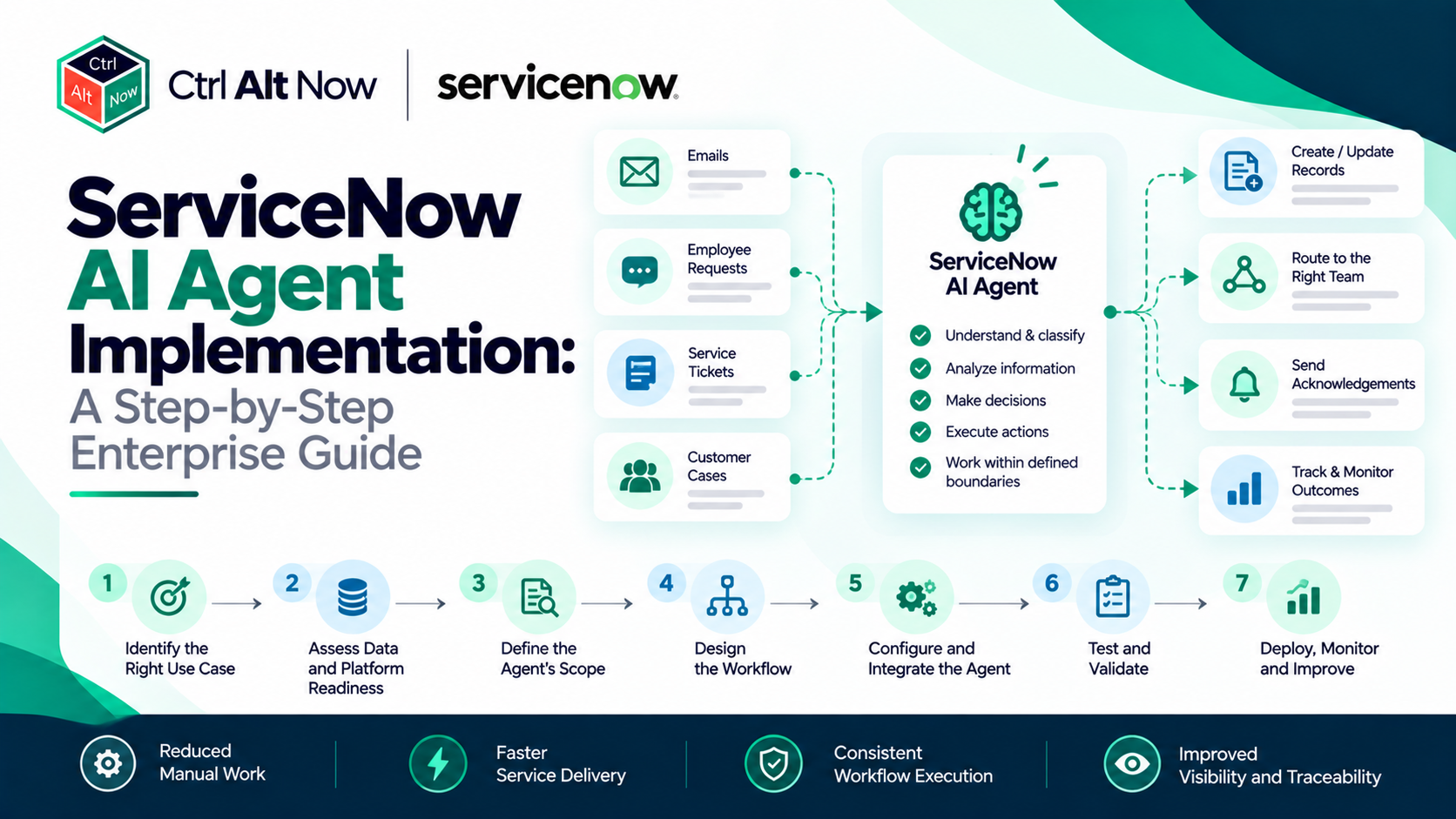
Enterprises are increasingly adopting AI to automate repetitive tasks, improve service delivery, and streamline business workflows. Within ServiceNow, AI agents can help interpret requests, make decisions within defined boundaries, and execute configured actions across enterprise processes.
Successful ServiceNow AI agent implementation requires more than deploying an AI tool. Organizations need clearly defined use cases, reliable data, appropriate integrations, governance, and measurable business objectives.
What Is ServiceNow AI Agent Implementation?
ServiceNow AI agent implementation involves designing, configuring, integrating, and deploying AI agents to perform specific tasks within ServiceNow workflows.
Using capabilities such as Now Assist, AI Agent Studio, and Flow Designer where appropriate, organizations can develop workflows that support tasks such as interaction triage, request handling, information retrieval, and service operations.
The capabilities available depend on the ServiceNow products, licensing, configuration, and integrations in use.
Benefits of ServiceNow AI Agent Implementation
1. Reduced Manual Work
AI agents can handle repetitive activities, allowing employees to focus on complex requests and higher-value tasks.
2. Faster Service Delivery
Automating intake, classification, and routing can help reduce delays between receiving a request and beginning work.
3. Consistent Workflow Execution
Agents can follow defined instructions and business rules to support more consistent processing.
4. Improved Visibility and Traceability
Appropriately configured workflows can record actions and decisions, helping teams review outcomes and investigate exceptions.
Step-by-Step Guide to ServiceNow AI Agent Implementation
Step 1: Identify the Right Use Case
Start with a repetitive, well-defined business process. Examples include email triage, incident classification, request routing, and customer case intake.
Evaluate the process based on business value, frequency, complexity, and risk.
Step 2: Assess Data and Platform Readiness
Review data quality, existing workflows, permissions, integrations, and relevant ServiceNow capabilities. Reliable information is essential for accurate and useful agent outcomes.
Step 3: Define the Agent’s Scope
Specify what the agent can do, which systems and records it can access, and when it must request human assistance.
Clear boundaries help reduce unintended actions and keep the implementation aligned with business requirements.
Step 4: Design the Workflow
Map the complete process from the initial request to the final outcome.
For example, an interaction-triage agent may:
- Read and classify an incoming email.
- Validate whether sufficient information is available.
- Determine the appropriate record type and routing.
- Create the incident, request, or case.
- Send a contextual acknowledgement.
- Record a summary of the actions taken.
If information is incomplete or confidence is insufficient, the workflow should route the request for clarification or human review.
Step 5: Configure and Integrate the Agent
Configure the agent using suitable ServiceNow capabilities and connect it to the required workflows and data sources. Apply access controls and validate that each action follows approved business rules.
Step 6: Test and Validate
Test normal scenarios, incomplete requests, incorrect information, access restrictions, and unexpected inputs. Measure accuracy, exception rates, processing time, and workflow completion.
Begin with human review where appropriate before expanding autonomous execution.
Step 7: Deploy, Monitor, and Improve
Roll out the agent in phases. Monitor performance, review execution logs, collect user feedback, and update instructions or workflows when issues arise.
Ongoing monitoring helps ensure that the agent remains useful as business requirements change.
Governance and Security Considerations
Enterprise AI agents must operate within appropriate controls. Organizations should establish:
- Role-based access and least-privilege permissions
- Human approval for sensitive or high-impact actions
- Clear exception-handling procedures
- Audit logs and execution traceability
- Data privacy and security controls
- Regular performance and compliance reviews
These measures help balance automation with accountability.
How CtrlAltNow Can Help
CtrlAltNow helps enterprises explore and implement ServiceNow solutions aligned with their operational requirements. Its AI agent implementation approach can include use-case assessment, workflow design, configuration, integration planning, governance, testing, and ongoing optimization.
By starting with a focused use case and expanding based on validated results, organizations can build a practical foundation for enterprise AI automation.
Conclusion
Successful ServiceNow AI agent implementation combines the right use cases, reliable data, well-designed workflows, secure integrations, and continuous monitoring. A phased approach allows enterprises to validate results, manage risks, and expand automation responsibly.
With the right implementation strategy, CtrlAltNow can help organizations explore AI-powered ServiceNow workflows that improve operational efficiency, service responsiveness, and process consistency.


Leave A Comment